
Tag: Linux

PyGTK Threaded Nautilus Filebot

As a heavy user of Nautilus and Filebot, i decided to integrate the two.
Following on from my previous article on column providers for nautilus, here as the additional functionality for nautilus filebot integration.
Its a basic threaded extension; for the most basic and most used operation, \u201cStrict file renaming\u201d.

It solves 95% of my usage scenarios. To find out how to use the code, see the article https://fio.ie/python-column-provider-nautilus/

Github: https://github.com/dmzoneill/filebot-nautilus
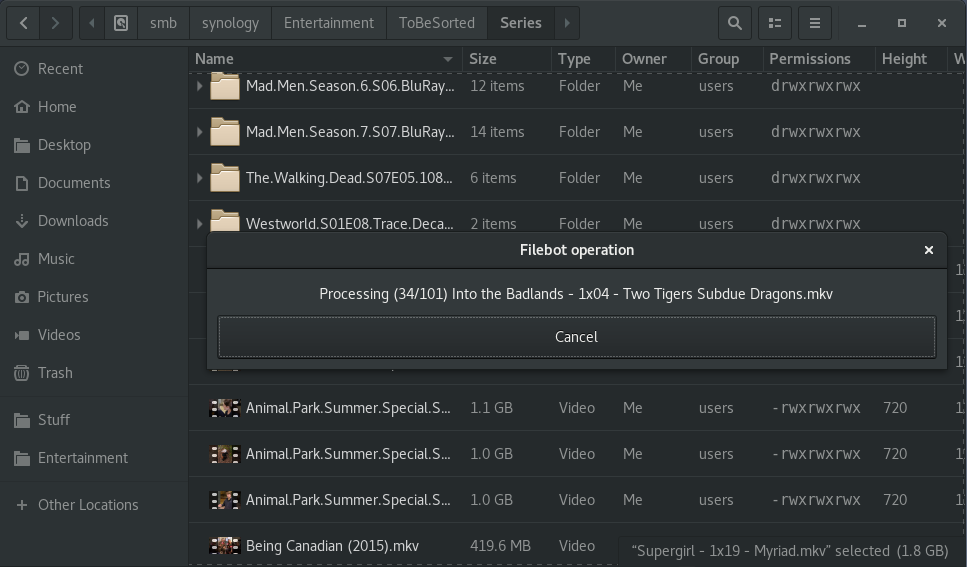
FileBot Nautilus

The code

#!/usr/bin/python

# dave@fio.ie

import os
import urllib
import logging
import re
import threading

import gi
gi.require_version('Nautilus', '3.0')
gi.require_version('Gtk', '3.0')

from gi.repository import Nautilus, GObject, Gtk, Gdk, GLib, GdkPixbuf
from hachoir_core.error import HachoirError
from hachoir_core.stream import InputIOStream
from hachoir_parser import guessParser
from hachoir_metadata import extractMetadata
from subprocess import Popen, PIPE

GObject.threads_init()


class VideoMetadataExtension(GObject.GObject, Nautilus.ColumnProvider, Nautilus.MenuProvider, Nautilus.InfoProvider):

  def __init__(self):
  
    logging.basicConfig(filename='/tmp/VideoMetadataExtension.log',level=logging.DEBUG)
    
    self.videomimes = [
      'video/x-msvideo',
      'video/mpeg',
      'video/x-ms-wmv',
      'video/mp4',
      'video/x-flv',
      'video/x-matroska'
    ]
    
    self.win = None


  def get_columns(self):
  
    return (
      Nautilus.Column(name="NautilusPython::video_width_columnn",attribute="video_width",label="Width",description="Video width"),
      Nautilus.Column(name="NautilusPython::video_height_columnn",attribute="video_height",label="Height",description="Video height"),
    )


  def update_file_info_full(self, provider, handle, closure, file_info):
  
    filename = urllib.unquote(file_info.get_uri()[7:]) 
    video_width = ''
    video_height = ''
    name_suggestion = ''

    file_info.add_string_attribute('video_width', video_width)
    file_info.add_string_attribute('video_height', video_height)
    file_info.add_string_attribute('name_suggestion', name_suggestion)  
  
    if file_info.get_uri_scheme() != 'file':
      logging.debug("Skipped: " + filename)
      return Nautilus.OperationResult.COMPLETE
      
    for mime in self.videomimes:
      if file_info.is_mime_type(mime):
        GObject.idle_add(self.get_video_metadata, provider, handle, closure, file_info)
        logging.debug("in Progress: " + filename)
        return Nautilus.OperationResult.IN_PROGRESS
         
    logging.debug("Skipped: " + filename)
    
    return Nautilus.OperationResult.COMPLETE


  def get_file_items_full(self, provider, window, files):
  
    for mime in self.videomimes:
      for file in files:
        if file.get_uri_scheme() == 'file' and file.is_mime_type(mime):
      
          top_menuitem = Nautilus.MenuItem(name='NautilusPython::Filebot', label='Filebot', tip='Filebot renamer')

          submenu = Nautilus.Menu()
          top_menuitem.set_submenu(submenu)

          filebot_tvdb_menuitem = Nautilus.MenuItem(name='NautilusPython::FilebotRenameTVDB', label='Filebot TVDB', tip='Fetch names from TVDB')
          filebot_tvdb_menuitem.connect('activate', self.filebot_activate_cb, files, 'tvdb')
          submenu.append_item(filebot_tvdb_menuitem)

          filebot_moviedb_menuitem = Nautilus.MenuItem(name='NautilusPython::FilebotRenameMoviewDB', label='Filebot MovieDB', tip='Fetch names from MovieDB')
          filebot_moviedb_menuitem.connect('activate', self.filebot_activate_cb, files, 'moviedb')
          submenu.append_item(filebot_moviedb_menuitem)

          return top_menuitem,


  def filebot_activate_cb(self, menu, files, source):
  
    self.win = FileBotWindow(self, source, files)
    self.win.connect("delete-event", Gtk.main_quit)
    self.win.show_all()
    Gtk.main()
        

  def get_video_metadata(self, provider, handle, closure, file_info):
  
    video_width = ''
    video_height = ''
    name_suggestion = ''
  
    filename = urllib.unquote(file_info.get_uri()[7:])  
    filelike = open(filename, "rw+")
    
    try:
      filelike.seek(0)
    except (AttributeError, IOError):
      logging.debug("Unabled to read: " + filename)
      Nautilus.info_provider_update_complete_invoke(closure, provider, handle, Nautilus.OperationResult.FAILED)
      return False

    stream = InputIOStream(filelike, None, tags=[])
    parser = guessParser(stream)

    if not parser:
      logging.debug("Unabled to determine parser: " + filename)
      Nautilus.info_provider_update_complete_invoke(closure, provider, handle, Nautilus.OperationResult.FAILED)
      return False

    try:
      metadata = extractMetadata(parser)
    except HachoirError:
      logging.debug("Unabled to extract metadata: " + filename)
      Nautilus.info_provider_update_complete_invoke(closure, provider, handle, Nautilus.OperationResult.FAILED)
      return False
          
    if metadata is None:
      logging.debug("Metadata None: " + filename)
      Nautilus.info_provider_update_complete_invoke(closure, provider, handle, Nautilus.OperationResult.FAILED)
      return False

    matchObj = re.search( r'Image width: (.*?) pixels', str(metadata), re.M|re.I)

    if matchObj:
       video_width = matchObj.group(1)
        
    matchObj = re.search( r'Image height: (.*?) pixels', str(metadata), re.M|re.I)

    if matchObj:
       video_height = matchObj.group(1)

    file_info.add_string_attribute('video_width', video_width)
    file_info.add_string_attribute('video_height', video_height)
    file_info.add_string_attribute('name_suggestion', name_suggestion)   
    
    logging.debug("Completed: " + filename)
    
    file_info.invalidate_extension_info()
    
    Nautilus.info_provider_update_complete_invoke(closure, provider, handle, Nautilus.OperationResult.COMPLETE)
    
    return False
    

class FileBotWindow(Gtk.Window):

  def __init__(self, videoMetadataExtension, source, files):
    
    self.todo = len(files)
    self.processing = 0
    self.files = files
    self.source = source
    self.quit = False
    
    self.videoMetadataExtension = videoMetadataExtension

    Gtk.Window.__init__(self, title="Filebot operation")
    self.set_size_request(200, 100)
    self.set_border_width(10)
    self.set_type_hint(Gdk.WindowTypeHint.DIALOG)

    vbox = Gtk.Box(orientation=Gtk.Orientation.VERTICAL, spacing=6)
    self.add(vbox)

    self.working_label = Gtk.Label(label="Working")
    vbox.pack_start(self.working_label, True, True, 0)

    self.button = Gtk.Button(label="Cancel")
    self.button.connect("clicked", self.on_button_clicked)
    vbox.pack_start(self.button, True, True, 0)
    
    #GObject.timeout_add_seconds(1, self.process, files, source)
    self.update = threading.Thread(target=self.process)
    self.update.setDaemon(True)
    self.update.start()
             
        
  def process(self):
 
    for file in self.files:
      if file.get_uri_scheme() != 'file':
        continue
  
      filename = urllib.unquote(file.get_uri()[7:])
      self.filebot_process(filename)

    
  def on_button_clicked(self, widget):
    self.quit = True  
    self.close()
    

  def filebot_process(self, filename): 
    
    if self.quit == True:
      return
    
    self.processing = self.processing + 1
    text = "Processing (" + str(self.processing) + "/" + str(self.todo) + ") " + os.path.basename(filename)
    GObject.idle_add( self.working_label.set_text, text, priority=GObject.PRIORITY_DEFAULT )
        
    p = Popen(['filebot', '-rename', filename,'--db', self.source], stdin=PIPE, stdout=PIPE, stderr=PIPE)
    output, err = p.communicate(b"input data that is passed to subprocess' stdin")
    rc = p.returncode

    if self.processing == self.todo:
      GObject.idle_add( self.close, priority=GObject.PRIORITY_DEFAULT )
Python column provider for Gnome Files (Nautilus)

Below is an example of a python column provider for nautilus.
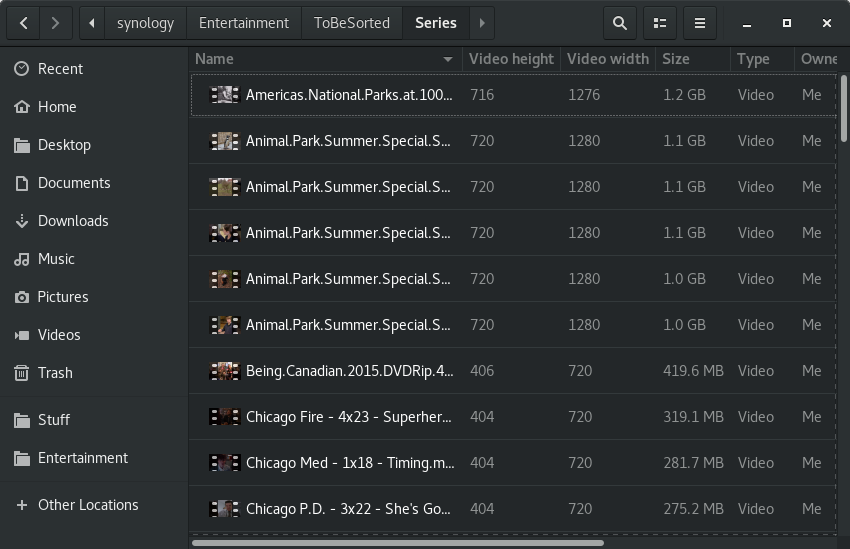
Identifying poor quality video files 480p, 720p \u2026 is difficult in nautilus at a glance.

You need to open the file properties to view the video metadata.
While there are a number of extensions out there for EXIF etc, i decided to implement my own.
Originally i tried to use MediaInfo, but it was far too slow. This is what i ended up with.

To activate it, just login and logout, or kill nautilus and restart it.

preview nautilus

Create target directory and file

mkdir -vp ~/.local/share/nautilus-python/extensions
touch ~/.local/share/nautilus-python/extensions/VideoMetaData.py

Install python libraries

pip install hachoir-metadata
pip install hachoir-parser
pip install hachoir-core

Add this to ~/.local/share/nautilus-python/extensions/VideoMetaData.py

#!/usr/bin/python

# dave@fio.ie

import os
import urllib
import logging
import re

import gi
gi.require_version('Nautilus', '3.0')
gi.require_version('Gtk', '3.0')

from gi.repository import Nautilus, GObject, Gtk, Gdk, GdkPixbuf
from hachoir_core.error import HachoirError
from hachoir_core.stream import InputIOStream
from hachoir_parser import guessParser
from hachoir_metadata import extractMetadata


class VideoMetadataExtension(GObject.GObject, Nautilus.ColumnProvider, Nautilus.MenuProvider, Nautilus.InfoProvider):

  def __init__(self):
    logging.basicConfig(filename='/tmp/VideoMetadataExtension.log',level=logging.DEBUG)
    pass


  def get_columns(self):
    return (
      Nautilus.Column(name="NautilusPython::video_width_columnn",attribute="video_width",label="Width",description="Video width"),
      Nautilus.Column(name="NautilusPython::video_height_columnn",attribute="video_height",label="Height",description="Video height"),
    )


  def update_file_info_full(self, provider, handle, closure, file_info):
  
    filename = urllib.unquote(file_info.get_uri()[7:]) 
    video_width = ''
    video_height = ''
    name_suggestion = ''

    file_info.add_string_attribute('video_width', video_width)
    file_info.add_string_attribute('video_height', video_height)
    file_info.add_string_attribute('name_suggestion', name_suggestion)  
  
    if file_info.get_uri_scheme() != 'file':
      logging.debug("Skipped: " + filename)
      return Nautilus.OperationResult.COMPLETE
      
    videomimes = [
      'video/x-msvideo',
      'video/mpeg',
      'video/x-ms-wmv',
      'video/mp4',
      'video/x-flv',
      'video/x-matroska'
    ]
    
    for mime in videomimes:
      if file_info.is_mime_type(mime):
        GObject.idle_add(self.get_video_metadata, provider, handle, closure, file_info)
        logging.debug("in Progress: " + filename)
        return Nautilus.OperationResult.IN_PROGRESS
         
    logging.debug("Skipped: " + filename)
    
    return Nautilus.OperationResult.COMPLETE


  def get_video_metadata(self, provider, handle, closure, file_info):
  
    video_width = ''
    video_height = ''
    name_suggestion = ''
  
    filename = urllib.unquote(file_info.get_uri()[7:])  
    filelike = open(filename, "rw+")
    
    try:
      filelike.seek(0)
    except (AttributeError, IOError):
      logging.debug("Unabled to read: " + filename)
      Nautilus.info_provider_update_complete_invoke(closure, provider, handle, Nautilus.OperationResult.FAILED)
      return False

    stream = InputIOStream(filelike, None, tags=[])
    parser = guessParser(stream)

    if not parser:
      logging.debug("Unabled to determine parser: " + filename)
      Nautilus.info_provider_update_complete_invoke(closure, provider, handle, Nautilus.OperationResult.FAILED)
      return False

    try:
      metadata = extractMetadata(parser)
    except HachoirError:
      logging.debug("Unabled to extract metadata: " + filename)
      Nautilus.info_provider_update_complete_invoke(closure, provider, handle, Nautilus.OperationResult.FAILED)
      return False
          
    if metadata is None:
      logging.debug("Metadata None: " + filename)
      Nautilus.info_provider_update_complete_invoke(closure, provider, handle, Nautilus.OperationResult.FAILED)
      return False

    matchObj = re.search( r'Image width: (.*?) pixels', str(metadata), re.M|re.I)

    if matchObj:
       video_width = matchObj.group(1)
        
    matchObj = re.search( r'Image height: (.*?) pixels', str(metadata), re.M|re.I)

    if matchObj:
       video_height = matchObj.group(1)

    file_info.add_string_attribute('video_width', video_width)
    file_info.add_string_attribute('video_height', video_height)
    file_info.add_string_attribute('name_suggestion', name_suggestion)   
    
    logging.debug("Completed: " + filename)
    
    file_info.invalidate_extension_info()
    
    Nautilus.info_provider_update_complete_invoke(closure, provider, handle, Nautilus.OperationResult.COMPLETE)
    
    return False

Golang script to pull bandwidth usage from digiweb

I wrote the following script to pull broadband usage form digiweb.

Its fairly hilarious that digiweb are so badly organized.
They are still using smart telecom forums for customers to access pertinent data.
Furthermore the connection is http rather than https.

Here’s to passing un-encrypted passwords over the wire! 🙂

Digiweb figures are exactly 10% more that what DD-WRT reports. Interesting observation 😉

Enjoy 😉

package main

import (
    "fmt"
    "strconv"
    "net/http"
    "net/http/cookiejar"
    "crypto/tls"
    "io/ioutil"
    "crypto/md5"
    "encoding/hex"
    "net/url"
    "strings"
    "regexp"
)

var _smart_username = "username"
var _smart_password = "password"
var _modem_username = "0123456789"
var _modem_password = "password"
var _forum_endpoint = "http://support.smarttelecom.ie/forums/login.php?do=login"
var _usage_endpoint = "http://support.smarttelecom.ie/forums/smart_usage"

func GetMD5Hash(text string) string {
    hasher := md5.New()
    hasher.Write([]byte(text))
    return hex.EncodeToString(hasher.Sum(nil))
}

func getusage() {
    tr := &http.Transport {
        TLSClientConfig: &tls.Config { InsecureSkipVerify: true },
    }
    
    cookieJar, _ := cookiejar.New(nil)

    client1 := &http.Client { Transport: tr, Jar: cookieJar }
    
    form1 := url.Values{}
    form1.Add( "vb_login_username", _smart_username )
    form1.Add( "vb_login_password", "" )
    form1.Add( "s", "" )
    form1.Add( "securitytoken", "guest" )
    form1.Add( "do", "login" )
    form1.Add( "vb_login_md5password", GetMD5Hash( _smart_password ) )
    form1.Add( "vb_login_md5password_utf", GetMD5Hash( _smart_password ) )
    
    //fmt.Printf("%s", GetMD5Hash(_smart_password))
    
    req1, err := http.NewRequest( "POST", _forum_endpoint, strings.NewReader(form1.Encode()) )
    req1.Header.Add( "Content-Type", "application/x-www-form-urlencoded" )
    
    resp1, err := client1.Do( req1 )
    defer resp1.Body.Close()

    if err != nil {
        fmt.Printf( "Error : %s", err)
    }

    if resp1.StatusCode != 200 {
        fmt.Printf( "Error code: %s", strconv.Itoa( resp1.StatusCode ) )
    }
    
            
    client2 := &http.Client { Transport: tr, Jar: cookieJar }
    
    form2 := url.Values{}
    form2.Add( "user", _modem_username )
    form2.Add( "pass", _modem_password )
    form2.Add( "submit", "SUBMIT" )
    
    req2, err := http.NewRequest( "POST", _usage_endpoint, strings.NewReader(form2.Encode()) )
    req2.Header.Add( "Content-Type", "application/x-www-form-urlencoded" )
    
    resp2, err := client2.Do( req2 )
    defer resp2.Body.Close()
    
    if err != nil {
        fmt.Printf( "Error : %s", err)
    }

    if resp1.StatusCode != 200 {
        fmt.Printf( "Error code: %s", strconv.Itoa( resp1.StatusCode ) )
    }    

    bodyBytes2, err := ioutil.ReadAll( resp2.Body )
    if err != nil {
        fmt.Printf( "Error : %s", err )
    }
    
    //fmt.Printf( "%s\n", bodyBytes2 )
    
    re := regexp.MustCompile( "(?s)<table width=800 border=\"0\" style=\"border-collapse:collapse;\" cellspacing=\"0\">(.*)</table>" )
    matches := re.FindAllString( string(bodyBytes2), -1 )
        
    for i := len( matches )-1; i >= 0; i-- {
        reinout := regexp.MustCompile( "(?s)<td>(.*?)</td>" )
        inout := reinout.FindAllString( matches[i] , -1 )
        
        //fmt.Printf( "%v\n", inout[0][4:len(inout[0])-5] )
        //fmt.Printf( "%v\n", inout[1][4:len(inout[1])-5] )
        //fmt.Printf( "%v\n", inout[2][4:len(inout[2])-5] )
        //fmt.Printf( "%v\n", inout[3][4:len(inout[3])-5] )
        //fmt.Printf( "%v\n", inout[4][4:len(inout[4])-5] )
        //fmt.Printf( "%v\n", inout[5][4:len(inout[5])-5] )
        //fmt.Printf( "%v\n", inout[6][4:len(inout[6])-5] )
        //fmt.Printf( "%v\n", inout[7][4:len(inout[7])-5] )
        //fmt.Printf( "%v\n", inout[8][4:len(inout[8])-5] )
        //fmt.Printf( "%v\n", inout[9][4:len(inout[9])-5] )
        //fmt.Printf( "%v\n", inout[10][4:len(inout[10])-5] )
        
        i := strings.Index(inout[11], "(") + 1
        fmt.Printf( "%v\n", inout[11][i:len(inout[11])-10] )       
        
    }
}


func main() {
    getusage()
}

Golang DD-WRT Bandwidth Usage with Conky

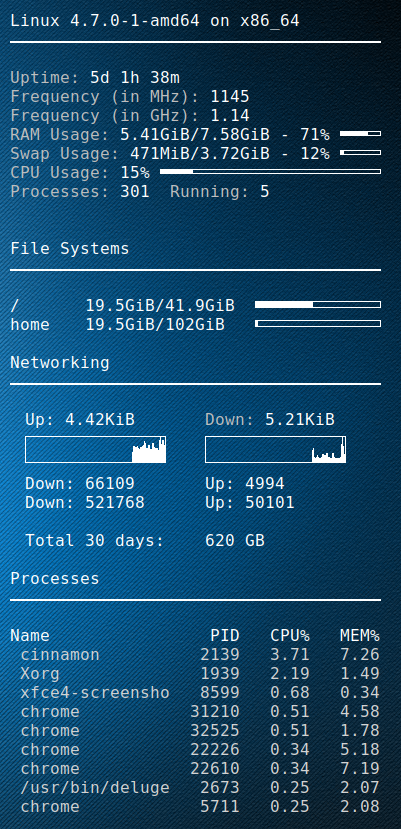
I setup a golang script to fetch the DD-WRT bandwidth usage for the previous 2 months, as well as the last 30 days(rolling).
Using conky then i can display it on my desktop.
My ISP (digiweb), don’t provide any means to check your bandwidth.
Picture at end of post 🙂

Golang DD-WRT script


package main

import (
    "fmt"
    "strconv"
    "net/http"
    "crypto/tls"
    "io/ioutil"
    "regexp"
    "time"
)

// You set these
var _ddwrt_ip = "10.1.1.1"
var _ddwrt_ssl = true
var _ddwrt_port = 443
var _ddwrt_user = "root"
var _ddwrt_pass = "password"

// don't set these
var _ddwrt_this_month = ""
var _ddwrt_last_month = ""

func printmonth(monthyear string) {
    tr := &http.Transport {
        TLSClientConfig: &tls.Config { InsecureSkipVerify: true },
    }

    client := &http.Client { Transport: tr }

    proto := "http"
    if _ddwrt_ssl == true {
      proto = "https"
    }

    req, err := http.NewRequest( "GET", proto + "://" + _ddwrt_ip + ":" + strconv.Itoa( _ddwrt_port ) + "/ttgraph.cgi?" + monthyear, nil )
    req.SetBasicAuth( _ddwrt_user, _ddwrt_pass )

    resp, err := client.Do( req )
    defer resp.Body.Close()

    if err != nil {
        fmt.Printf( "Error : %s", err)
    }

    if resp.StatusCode != 200 {
        fmt.Printf( "Error code: %s", strconv.Itoa( resp.StatusCode ) )
    }

    bodyBytes, err2 := ioutil.ReadAll( resp.Body )
    if err2 != nil {
        fmt.Printf( "Error : %s", err2 )
    }
    
    if len( _ddwrt_this_month ) == 0 {
        _ddwrt_this_month = string( bodyBytes )
    } else {
        _ddwrt_last_month = string( bodyBytes )
    }

    re := regexp.MustCompile( "(?s)<li id=\"label\">(.*?)</li>" )
    matches := re.FindAllString( string( bodyBytes ), -1 )

    rein := regexp.MustCompile( "(?s)Incoming: ([0-9]+)" )
    reinmatches := rein.FindStringSubmatch( matches[0] )

    reout := regexp.MustCompile( "(?s)Outgoing: ([0-9]+)" )
    reoutmatches := reout.FindStringSubmatch( matches[0] )

    fmt.Printf( "${goto 20}Down: %s ${goto 200}Up: %s\n", reinmatches[1], reoutmatches[1] )
}

func parse30days() {
    
    var all = _ddwrt_last_month + _ddwrt_this_month
    
    re := regexp.MustCompile( "(?s)onmouseover=\"Show(.*?)onmouseout" )
    matches := re.FindAllString( all, -1 )
    
    var down int64
    var up int64
    var total int64
    var days30 = 30
    
    for i := len( matches )-1; i >= 0; i-- {
        reinout := regexp.MustCompile( "(?s)Incoming: ([0-9]+) MB / Outgoing: ([0-9]+) MB" )
        inout := reinout.FindStringSubmatch( matches[i] )
        r, _ := strconv.ParseInt( inout[1], 10, 64 )
        
        if r == 0 {
            continue;
        }
        
        down = down + r
        
        t, _ := strconv.ParseInt( inout[2], 10, 64 )
        up = up + t
        
        days30--
        
        if days30 == 0 {
           break;
        }
    }

    
    total = down + up
    fmt.Printf( "\n${goto 20}Total 30 days:${goto 200}%d GB\n", total / 1024 )
}

func main() {
    now := time.Now()
    monthyear := now.Format("01-2006")
    printmonth(monthyear)
    monthyear = now.AddDate(0,-1,0).Format("01-2006")
    printmonth(monthyear)
    parse30days()
}

Conky script Integration


conky.config = {
    alignment = 'top_right',
    background = true,
    border_width = 1,
    cpu_avg_samples = 2,
	default_color = 'white',
    default_outline_color = 'white',
    default_shade_color = 'white',
    draw_borders = false,
    draw_graph_borders = true,
    draw_outline = false,
    draw_shades = false,
    use_xft = true,
    font = 'DejaVu Sans Mono:size=12',
    gap_x = 50,
    gap_y = 50,
    double_buffer = true,
    minimum_height = 5,
	minimum_width = 5,
    net_avg_samples = 2,
    no_buffers = true,
    out_to_console = false,
    out_to_stderr = false,
    extra_newline = false,
    own_window = true,
    own_window_class = 'Conky',
    own_window_type = 'desktop',
    own_window_transparent = true,
    stippled_borders = 0,
    update_interval = 3.0,
    uppercase = false,
    use_spacer = 'none',
    show_graph_scale = false,
    show_graph_range = false
}

conky.text = [[
$sysname $kernel on $machine
${hr 2}

${color grey}Uptime:$color $uptime
${color grey}Frequency (in MHz):$color $freq
${color grey}Frequency (in GHz):$color $freq_g
${color grey}RAM Usage:$color $mem/$memmax - $memperc% ${membar 4}
${color grey}Swap Usage:$color $swap/$swapmax - $swapperc% ${swapbar 4}
${color grey}CPU Usage:$color $cpu% ${cpubar 4}
${color grey}Processes:$color $processes  ${color grey}Running:$color $running_processes


${color}File Systems
${hr 2}

/${goto 80}$color${fs_used /}/${fs_size /} ${goto 250}${fs_bar 6 /}
/home${goto 80}$color${fs_used /}/${fs_size /home} ${goto 250}${fs_bar 6 /home}
 
${color}Networking
${hr 2}

${goto 20}Up:$color ${upspeed wlp3s0} ${goto 200}${color grey}Down:$color ${downspeed wlp3s0}
${goto 20}${upspeedgraph wlp3s0 26,140 FFFFFF FFFFFF}${goto 200}${downspeedgraph wlp3s0 26,140 FFFFFF FFFFFF}
${execpi 3600 /usr/bin/go run /home/dave/.conky/ddwrt-bandwidth.go}

${color}Processes
${hr 2}

Name                PID   CPU%   MEM%
${color lightgrey} ${top name 1} ${top pid 1} ${top cpu 1} ${top mem 1}
${color lightgrey} ${top name 2} ${top pid 2} ${top cpu 2} ${top mem 2}
${color lightgrey} ${top name 3} ${top pid 3} ${top cpu 3} ${top mem 3}
${color lightgrey} ${top name 4} ${top pid 4} ${top cpu 4} ${top mem 4}
${color lightgrey} ${top name 5} ${top pid 5} ${top cpu 5} ${top mem 5}
${color lightgrey} ${top name 6} ${top pid 6} ${top cpu 6} ${top mem 6}
${color lightgrey} ${top name 7} ${top pid 7} ${top cpu 7} ${top mem 7}
${color lightgrey} ${top name 8} ${top pid 8} ${top cpu 8} ${top mem 8}
${color lightgrey} ${top name 9} ${top pid 9} ${top cpu 9} ${top mem 9}

]]

Enjoy
rolling


Debian SID Opendmarc Installation and Configuration

In this post i will capture the installation of opendmarc and how its configure alongside Opendkim.

Install opendmarc

apt-get install opendmarc

Configure systemd service file

cat > /lib/systemd/system/opendkim.service <<EOT
[Unit]
Description=OpenDMARC Milter
Documentation=man:opendmarc(8) man:opendmarc.conf(5)
After=network.target nss-lookup.target 

[Service]
EnvironmentFile=/etc/default/opendmarc
Type=forking
PIDFile=/var/run/opendmarc/opendmarc.pid
User=opendmarc
ExecStart=/usr/sbin/opendkim -p $SOCKET -x /etc/opendmarc.conf -u opendmarc -P /var/run/opendmarc/opendmarc.pid
Restart=on-failure
ExecReload=/bin/kill -USR1 $MAINPID

[Install]
WantedBy=multi-user.target
EOT

The specific changes here are lines #9 EnvironmentFile #13 -p $SOCKET

Defaults File

cat > /etc/default/opendmarc <<EOT
SOCKET="inet:12302@localhost"
EOT

Opendmarc Config file

cat > /etc/opendmarc.conf <<EOT
AuthservID example.com
PidFile /var/run/opendmarc.pid
#RejectFailures false
Syslog true
SyslogFacility mail
UMask 0002
UserID opendmarc:opendmarc
TemporaryDirectory /tmp
AutoRestart true
EOT

Modify Postfix milters

If you are running both opendkim and opendmarc your milters will look like this:

non_smtpd_milters = inet:127.0.0.1:12301, inet:127.0.0.1:12302
smtpd_milters = inet:127.0.0.1:12301, inet:127.0.0.1:12302

Restart the service

systemctl daemon-reload
systemctl restart opendmarc
systemctl restart postfix

DNS

Now go modify your DNS, adding a TXT record ‘_dmarc‘with the value ‘v=DMARC1; p=none; rua=mailto:postmaster@example.com

When you have validated dmarc is working properly you can change p=none to p=reject

How can you validate it?

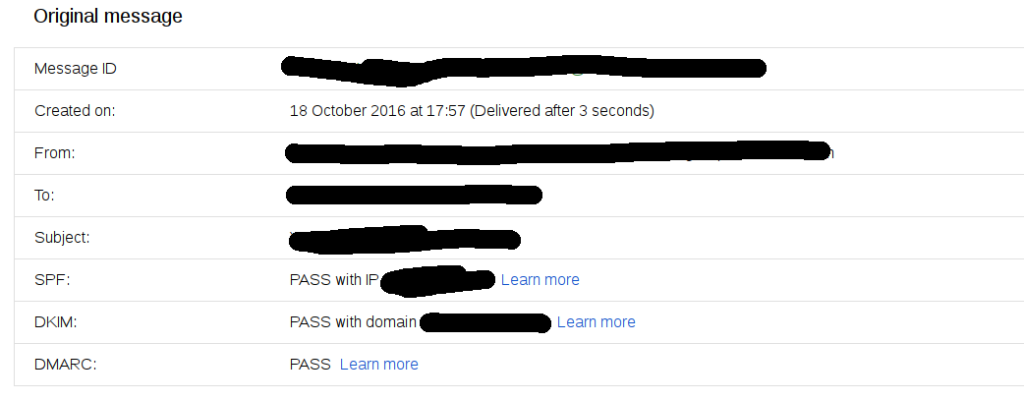
There are a number of tools online to help you with this, also you open up a mail in google and click ‘show original’.

screenshot_2016-11-20_12-32-23

Enjoy

Other resources

https://www.google.com/search?q=opendkim+setup

https://www.google.com/search?q=opendmarc+setup